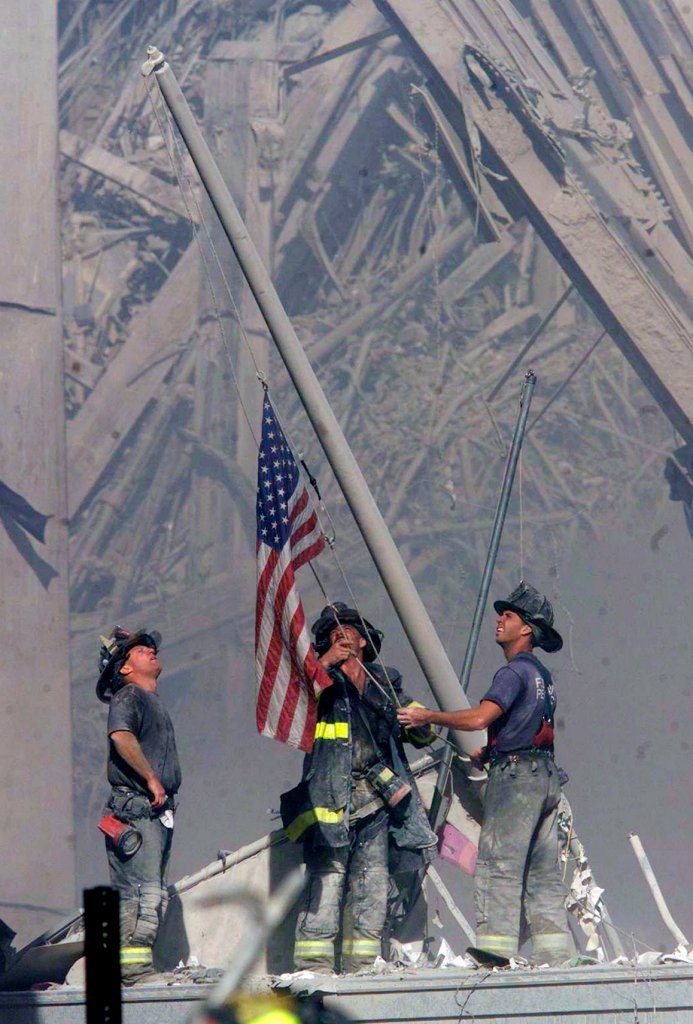
This photograph demonstrates a good use of balance because of the three similarly sized men at the bottom of the picture. They also form a triangle when combined with the flagpole. The majority of the image's weight is in the bottom.
This image obviously displays the use of lines using the dividers in the road. The lines lead the viewer's eye from the bottom to the top of the photograph. Also, the cars are moving in the same direction as the lines.
This image is a good example of the rule of thirds because the building is in the right third of the photo. Also, the sky only fills the top third of the photo, leaving the city to occupy the bottom two-thirds.
This photograph represents simplicity because the background is repetitive. The man really stands out against the building's window panels. Even though the lines differ in color, they are still constant.
1. Explain the "camera obscura" effect. How is it achieved? Inside a completely dark room, a tiny hole is created in one wall. Through the hole light is focused, and the outside scene is projected (upside down) on the opposite wall. 2. What invention during the 17th Century helped man get a step closer to creating the modern camera? The understanding of optics and the process of making high quality glass lenses. 3. What were the parts of the first modern camera invented by Niepce? He invented film. 4. What do modern digital cameras have in common with Niepce's camera? A digital camera is still composed of a lens, a dark box, and film. 5. What do digital cameras use to capture an image? An electronic sensor called a CCD. 6. What is the difference between the Auto mode and the Program mode? Auto mode is fully automatic, whereas you can control certain things like flash in Program mode. 7. What is the Portrait mode used for? How does it work? To attempt to blur out the background, the camera will try to use the fastest available lens setting (aperture). 8. What is the Sports mode used for? (not just sports) How does it work? To freeze motion, camera will use the highest shutter speed possible. 9. Why should you do a half press on the trigger button? It increases the camera's response time, gives you more control over focus, and encourages better composition. 10. What does this symbol mean? When would you use this? Auto-Flash. You'd use this when in default mode. 11. What does this symbol mean? When would you use this? Disabled flash. You'd use this when you want natural light. 12. What happens to your photo if there is too much light? The picture will be washed out. 13. What happens to your photo if there is not enough light? The picture will be too dark. 14. What is a "stop." A relative change in the brightness of light. 15. How many stops brighter is the new planet if there are two suns instead of one? One stop. 16. How many stops brighter is the new planet if there are four suns instead of one? Two stops. 17. What affect does a longer shutter speed of have? Lets more light into the picture. 18. What affect does a shorter shutter speed have? Lets less light into the picture. 19. What does the aperture control? It closes up to restrict light and opens up to let light through. 20. When adjusting the aperture, how can you increase the amount of light? Choose a lower aperture.